

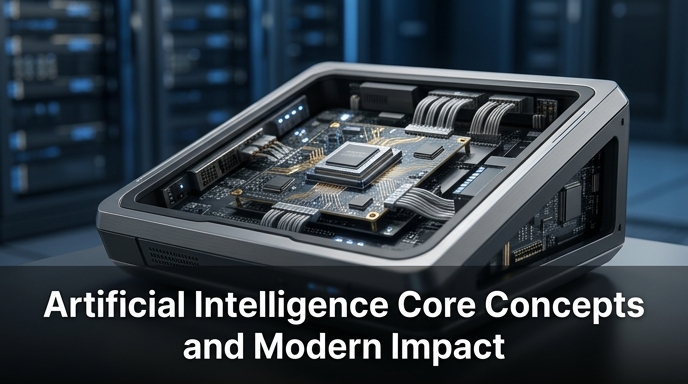
Advances in computing have brought a major transformation in how modern software operates. Contemporary computing systems no longer merely execute static lines of code; instead, they adaptively process information patterns. The application of artificial intelligence serves as the primary pillar behind this technological leap, delivering self-analytical capabilities that mirror human thinking processes.
Many people often ask about what is artificial intelligence in the context of everyday practical devices. This concept is not just a marketing buzzword in the gadget industry, but the foundation of system engineering that combines applied mathematics, probability statistics, and high-speed processing silicon design. Understanding the internal architecture of this technology provides insight into how smart gadgets recognize voices, predict computing needs, and change how humans interact with machines.
Engineering Footprints and the History of Artificial Intelligence
 The evolution of artificial intelligence began with theoretical discussions among mathematicians in the mid-twentieth century. Alan Turing proposed the Turing Test concept, which challenged computing capabilities to replicate human conversational responses indistinguishably.
The early phase of intelligent system development experienced ups and downs because of the limited computing power of hardware at the time. Early generation computers could not yet handle the massive volumes of data required to train complex mathematical models.
Interestingly, research resurgence accelerated rapidly when engineers began adapting graphics processor architectures for repetitive matrix calculations. Parallel computing successfully revived artificial neural network theories that had remained stalled on academic research papers for decades. From these classic foundations, breakthrough modern systems emerged, and they now power commercial devices efficiently.
Dissecting the Core Architecture Driving System Intelligence
The main strength of intelligent systems lies in the layered structure of algorithms that work to filter raw information into meaningful insights.
How Artificial Neural Networks and Data Modeling Work
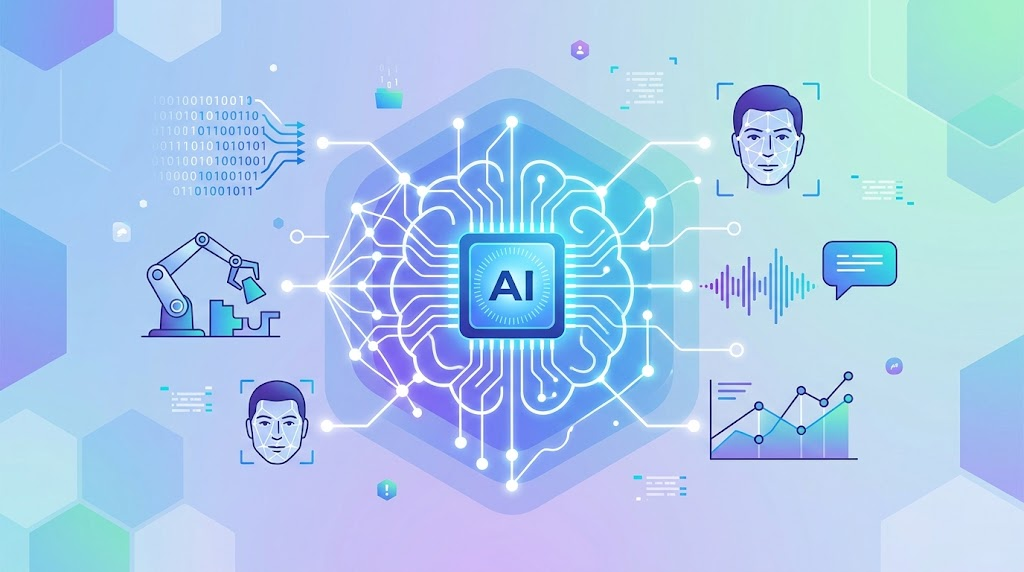
Machine learning models trained on billions of data points sit at the core of intelligent computational processing. These models recognize statistical correlations between data without needing rigid, manually programmed rules for every scenario.
Meanwhile, the structure of neural networks draws inspiration from biological cellular networks by dividing workloads into input layers, hidden layers, and output layers. When data enters, each computing node assigns specific numerical weights to generate precise final predictions. Deep Learning leverages dozens to hundreds of these calculation layers to extract abstract features, such as sound waves or visual textures.
Computer Vision and Natural Language Processing
Computer vision acts as another vital component transforming device interactions, as it translates image pixels into concrete object identification. Consequently, camera sensors can now recognize user facial contours in milliseconds to unlock screens securely.
On the other hand, the branch of Natural Language Processing addresses the complexities of human grammar so that systems can fully understand sentence context. Breakthroughs popularized by OpenAI through transformer architecture prove that machines can now consistently draft document summaries, translate languages, and generate functional code.
Real Transformation Through Artificial Intelligence in Tech
The application of artificial intelligence is shifting from massive cloud servers directly onto the physical circuits of consumer devices. This architectural change minimizes data latency while ensuring user information remains safe within local hardware.
Dedicated Silicon Integration in Consumer Hardware
Device processor manufacturers now embed independent neural processing units directly onto main silicon dies. These specialized semiconductor blocks execute low-power tensor calculations without burdening the main processor.
Compared to cloud processing that relies on stable internet signals, hardware-level processing offers instant response times. Smartphones can perform computational photography, reduce audio noise, and filter spam content independently without sending data to third-party servers.
Smart Automation in Industrial and Lifestyle Ecosystems
The benefits of advanced computing are becoming increasingly tangible through smart automation implementations across various commercial sectors. Intelligent systems can predict machine component failures before damage occurs, which significantly cuts repair costs.
Furthermore, algorithm architecture optimization in large-scale data centers automatically helps reduce cooling system energy consumption. Intelligent algorithms periodically monitor room heat loads and shift heavy workloads toward cooler server clusters to maintain optimal power efficiency.
Development Directions and Looking at the Future of Artificial Intelligence
The evolution of computing devices is moving toward increasingly autonomous, compact, and energy-efficient systems. We are entering a phase where inter-device interactions take place seamlessly without manual commands.
Here are several key pillars determining the future direction of intelligent computing:
- Micro-semiconductor power efficiency to run large inference models on small battery-powered devices.
- Transparency in processing logic so that every system decision can be traced and ethically accounted for.
- Strengthening edge computing privacy to ensure personal user data never leaves local device memory.
- Standardization of chip circuit security to prevent unauthorized tampering with training data.
As a recommendation for tech developers, focusing on lightweight software integration that is compatible with low-power chip architectures will be key to market success.
Entering a New Chapter in Applied Computing
The evolution of computing technology shows that intelligent systems are no longer merely scientific lab experiments. The massive transformation brought by artificial intelligence has changed how software and hardware serve human needs. Adaptability and processing speed open up endless opportunities for creating new, impactful innovations for broader society.
Understand how these intelligent systems work in depth to optimize technology usage in your work environment. Stay tuned to the latest developments in computing hardware, apply smart solutions responsibly, and leverage this technology to accelerate your productivity starting today.
Exploring Intelligent Computing Further
How do intelligent algorithms distinguish cat and dog photos on devices?
Systems analyze millions of pixels through visual filter layers to extract micro-features like ear shape, eye distance, and fur texture. Therefore, the highest probability value resulting from these matrix calculations determines the final classification accurately.
Why do intelligent computing processes require high-performance graphics cards?
Graphics cards have thousands of small processing cores working in parallel simultaneously. This architectural characteristic is ideal for computing large-scale matrix multiplications, which make up the main workload in training intelligent models.
What is the fundamental difference between conventional programming and machine learning systems?
Conventional programming requires developers to write logic rules manually to produce specific outputs. In contrast, intelligent systems learn from input data paired with expected outputs to discover their own underlying logic rules independently.
Is local data processing on a device secure for user privacy?
On-device processing at the silicon level is significantly more secure because sensitive data—such as voice recordings and facial scans—is processed directly within internal memory without being uploaded to external networks.
Why do massive language models sometimes produce incorrect answers?
Language models operate based on the probability of subsequent word occurrences derived from training data, rather than human-like conceptual understanding. If the input sentence is ambiguous or falls outside the scope of the training dataset, the system may generate responses that are incorrect yet grammatically convincing.